


On this page you’ll get an in-depth introduction to bast tree fibers and to the most well-known bast plant fibers: flax, hemp, ramie, nettle and jute. You’ll find out exactly where those fibers are located within the plant stem (you’ll be surprised how many fibers are in one plant), as well as the characteristics of each fiber.
Bast Fiber Features and Traits
The main features we’ll be discussing are the surface of the cells in the bast fiber (how smooth or folded is the surface?), and the diameter and shape of the cross section of the fiber (what does the fiber look like in cross-section?)
Here are some definitions, before we get into the main discussion:
You may see these terms when you are examining bast fibers.
- Fibril: a very fine, small thread — the diameter of a fibril is generally in the nanometer range; structurally, fibrils are the structural components of fibers.
- Fiber: a larger thread — the diameter of a fiber is generally in the micrometer to millimeter range; structurally, fibers are made up of fibrils.
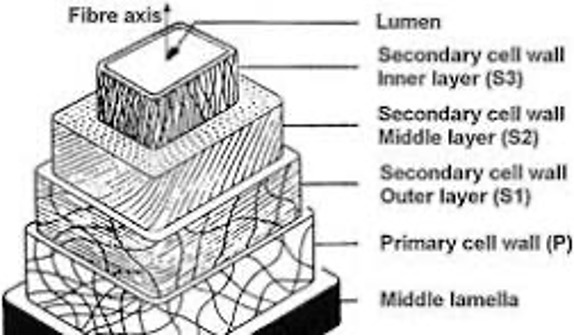
- Lumen: the empty area in the center of the plant stem; the discussion will usually be about its diameter and shape.
- Dislocations (nodes): the ring-shaped, slightly thicker areas that can be seen on many plant fibers.
- Cross markings: the attached wall remains of neighboring cells, or impressions made on the fiber cells by neighboring cells.
The Bast Fibers
Wood as a Bast Fiber
We’re going to start with tree bast fibers because they are the earliest bast fibers used by European (well, actually, pre-European) people. These fibers are contained in the phloem, the inner most layer of tree bark. (It is sometimes also referred to as the bast layer.) This is a vascular layer that transports sugars produced by photosynthesis in the leaves to other parts of the tree (and also other chemicals such as proteins and RNA).
There is a Very Good (and much more complete) description of the phloem here:
https://blog.woodland-ways.co.uk/bushcraft-other/bast-and-basswood/
This page also discusses retting the parts of the tree, and stripping off the fibers from the branches/bark of the tree. The earliest use of tree bast were as strips, harvested in the spring when the bark and bast layers were wet, and could be most easily torn from the trunk or substantial branches of trees. The strips were spliced together – spinning the fibers (and processing them down to a size where they could be spun) was a much later development.This is the third in a series of blogs all about tree bark. In the first we looked at some of the chemical components in bark, namely tannins. In the second we looked at the outer bark. In this blog we are focusing on the inner bark or the phloem and in particular the phloem of one family of trees.
To illustrate just how far back the interest in tree bast extends, there is this:
“A recent find of a Neanderthal tree bast string from Abri du Maras in France dates back to around 50,000 years ago, suggesting that the beginnings of textile crafts are even much earlier than hitherto believed, 20,000 years ago. … The cord fragment from Abri du Maras is the oldest direct evidence of fibre technology to date. Its production demonstrates a detailed ecological understanding of trees and how to transform them into entirely different functional substances.”
(Hardy BL, Moncel MH, Kerfant C, Lebon M, Bellot-Gurlet L, Mélard N
“Direct evidence of Neanderthal fibre technology and its cognitive and behavioral implications.” Sci Rep. (2020) v.10(1): 4889.)
The most common of the tree basts are:
• Oak (Quercus sp.): A particularly common fiber for the people living in the ancient (Neolithic/Bronze Age) lake dwellings of Central Europe (particularly Switzerland and Germany). Oak is high in tannins — important for both tanning and as a mordant for dyeing.
• Willow (Salix sp.): As with other tree basts, this was one of the most common sources of bast until recent times. Its bast is reddish in appearance.
• Lime/Linden (Tilia sp.): Linden has the longest fibers among the commonly-used tree basts, and could be processed into fine threads. It is stronger when wet, yet it doesn’t absorb very much water, and dries quickly.
The first appearances of non-tree bast fibers:
Working with tree bast for so long let humans perfect their skills at processing bast fibers, so with the beginning of settlements, when agriculture brought about the domestication of flax and other bast plants (e.g. hemp, nettle, jute, ramie), those skills were easily transferred to the new source plants (Leuzinger & Rast-Eicher, 2011, p. 535)
Flax (Linum sp.): Perhaps the most commonly recognized bast plant is the flax plant. As Antoinette Rast-Eicher wrote, in her book Fibres: Microscopy of Archaeological Textiles and Furs (2016): “Hardly any other plant among the textile fibres — besides hemp — has been more used or referred to than flax. Flax belongs to the earliest of domesticated plants.” (p. 87)
With the establishment of settlements and the introduction of farming around 7000 BCE (Bar-Yosef, 2020), flax was first cultivated for the oil inside its seeds, which was initially used for cooking. Later, the plant stems were also used for their fiber (Allaby, et al., 2005).
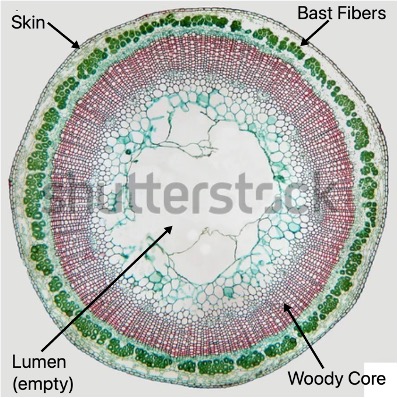
Flax cross-section
Because of the challenges of preservation, archaeological textile finds have always been much less common than other material. As such, even with evidence of pollen from flax or hemp plants, textile finds were often examined only through a standard light microscope, without further testing to identify them more specifically. Everything was automatically designated “flax” — the fiber most well-known by archaeologists.
Palynomorphic research (research of plant and animal structures that are microscopic in size — from ~5 μm to ~500 μm) can date flax back to the 7th millennium BC, with the possibility of going back much further. An exchange in the Journal Science in 2009 (which I have privately labelled as “The Controversy), discussed whether research dating some wild flax fibers as being 30,000 years old was scientifically rigorous enough to be accurate. The points being discussed showed several points that needed further examination:
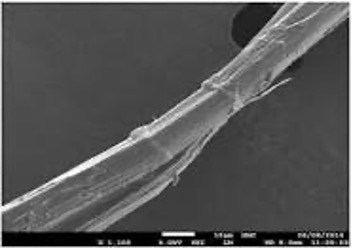
1) whether morphological observations in TLM/SEM showed that smooth on the surface (except for dislocations or cross-markings) was a way to differentiate bast fibers,
2) how the cross section of bast fibers (esp. flax, hemp and nettle) show the lumen of the plant stem (the hollow middle of the stem) show various shapes and diameters (polygonal, oval, flattened) among all of the fibers under discussion, especially flax.
Hemp (Cannabis sativa), like flax, is a multifunctional plant, used historically for textiles, cordage, oil, and medicinal & recreational drugs. It has an excellent resistance to rotting, and has long been important for rope construction and use on ships. Female plants are larger than male plants, and ripen later than male plants, after seeds are fully grown and ripe. It is well-known in China since the 5th millennium BC; and is mentioned in a 16th century BC papyrus from Egypt as a fiber and medicinal source.
Hemp fiber
In early medieval Europe, hemp was known but not well-documented in all areas: Anglo-Saxon England showed an increase in hemp pollen in the pollen profile, but hemp was rarely found in villages north of the Alps. Processing differed between Asia and Europe: in Asia, stalks were harvested before the type (male v. female) plants could be identified, and were peeled wet. Thread was made by splitting the bast into fine threads, and arranging them base-to-tip. This process is called “splicing” and has also been found to be used for both tree bast and flax. A final twist was added using a spindle, after the spliced thread has been wetted. This resembles linen thread production in Neolithic Europe. To soften the resulting thread, they are boiled with wood ash. In Europe, male plants are stripped off after shedding pollen and after being dried.
As a side note: The Northern New England Fibershed is working with the University of Vermont Extension Service (who are researching the agronomics of fiber hemp to establish a processing facility for long line fiber in North America (Rebecca Aviva Van Horn, Shuttle, Spindle & Dyepot, Spring 2025, p. 13.)
Nettle (Urtica dioica) was finally domesticated in the 19th century – one of the last bast fiber plants to be grown agriculturally, as opposed to being harvested in the wild. (Bredemann, G. 1959. Die groûe Brennessel Urtica dioica L. Forschung uÈber ihren Anbau zur Fasergewinnung. Akademieverlag, Berlin, Germany.)
Nettle fiber
Morphologically, observations of nettles using TLM/SEM microscopes show flexions and irregular flattened areas with flattened lumen; presence of oxalate crystals. In cross section, the plants show various shapes and diameters (polygonal, oval, flattened), especially in the lumen in the center of the plant.
Jute (Corchorus olitorius or Corchorus capsularis) comes mainly from India, Bangladesh, Pakistan and China. Composed mainly of cellulose and lignin, the fiber is used for textiles (especially burlap bags), construction (for stabilization in asphalt) and automotive industries. Seen through a light microscope, the fibers show distinct stripes, and have solitary calcium oxalate crystals.
The plant requires a retting process lasting a month to extract the fibers.
Jute fibers
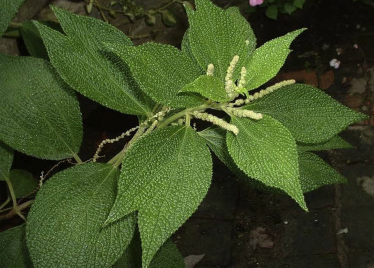
Ramie (Boehmeria nivea) (a relative of nettle) is a hardy perennial, grown in Asia, esp. China, but not very important archaeologically in Europe. “The Chinese processed green ramie to remove the fiber bundles, followed by soaking them in water and then splicing.” (Rast-Eicher, 2016, p. 109) It has long fibers – 40-150 cm. These are the longest (and strongest) known bast fibers, and are found in the bark of the plant. There is an irregular shape to the fibers, which are held together by gum and pectins, while other bast fibers are held together by lignin.
Ramie plant
Conclusion
This has been a brief introduction to some of the most archaeologically important fibers. While we all need to become familiar with the most prevalent fibers used in medieval life, we should all be aware that these fibers were not used exclusively. There are many others, particularly other bast fibers, that deserve our attention. It’s time to become creative.
Bibliography
Bredemann, G. 1959. Die groûe Brennessel Urtica dioica L. Forschung uÈber ihren Anbau zur Fasergewinnung. Akademieverlag, Berlin, Germany.
Guo, Y., Tataranni, P. , Sangiorgi, C., “The use of fibres in asphalt mixtures: A state of the art review” Construction and Building Materials, (2023) v. 390 : 131754.
Hardy BL, Moncel MH, Kerfant C, Lebon M, Bellot-Gurlet L, Mélard N. “Direct evidence of Neanderthal fibre technology and its cognitive and behavioral implications.” Sci Rep. (2020) v.10(1): 4889.
Rast-Eicher, Antoinette (2016), Fibres: Microscopy of Archaeological Textiles and Furs, Budapest: Archaeolingua Alapítvány.Van Horn, R. A., “Reviving Tradition: Northern New England’s Bast Fiber Renaissance”, Shuttle, Spindle & Dyepot,Spring 2025, v. 56 (issue 221): 13-15.